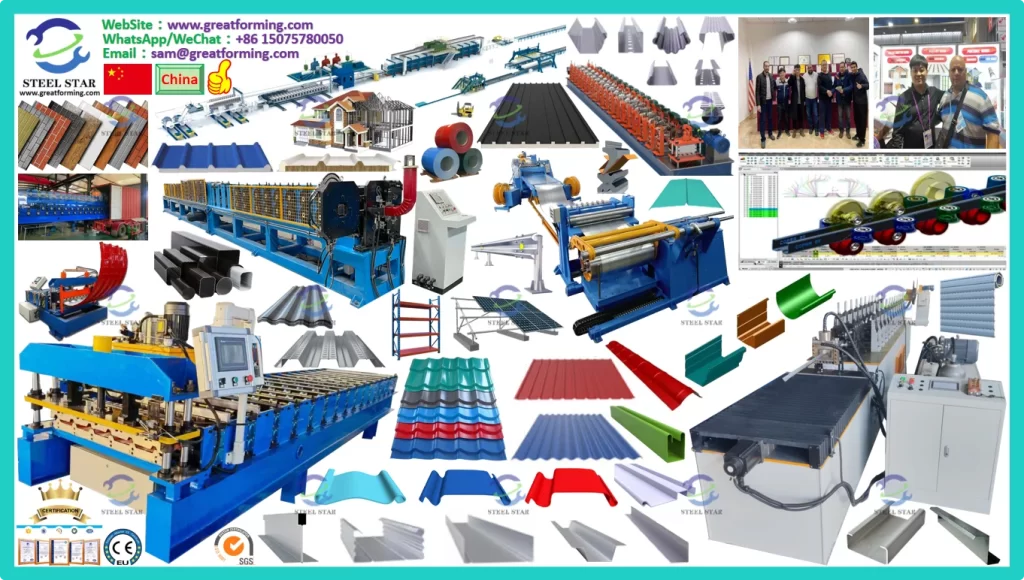





The Sheet Metal Roll Forming Machine: The Backbone of Modern Metal Fabrication
In the world of industrial manufacturing, precision, speed, and consistency are paramount. Few machines embody these principles as effectively as the Sheet Metal Roll Forming Machine. This equipment has quietly become the backbone of countless industries, from automotive and aerospace to construction and appliance manufacturing. By transforming flat metal coils into complex, custom-shaped profiles with remarkable efficiency, roll formers have revolutionized how we create structural and aesthetic metal components.
What is a Sheet Metal Roll Forming Machine?
A Sheet Metal Roll Forming Machine is a continuous bending system that processes long strips of sheet metal—typically coiled steel, aluminum, copper, or galvanized iron—into desired cross-sectional profiles. Unlike other metal forming processes such as stamping or press braking, which work on discrete pieces, roll forming uses a series of consecutive stations. Each station consists of a pair of hardened steel rolls (an upper and a lower roll) that progressively bend the metal as it passes through the line.
The magic lies in the sequence. The first pair of rolls may simply flatten or guide the strip. The next pair might form a slight bend. By the tenth or twentieth station, the flat strip has been transformed into a complex shape—such as a C-channel, a roof panel, a garage door slat, or a solar panel mounting rail—with perfect uniformity.
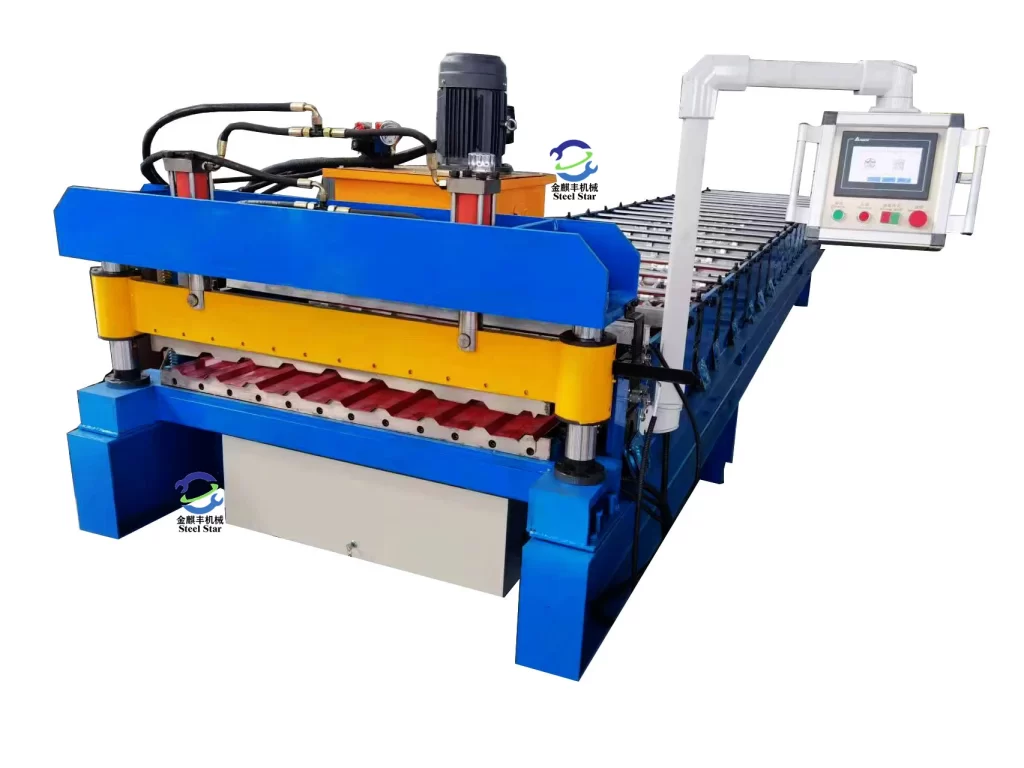
Key Components of a Roll Forming Line
A complete roll forming system is more than just the forming machine itself. A typical production line includes:
- Decoiler (Uncoiler): Holds and feeds the heavy metal coil under controlled tension.
- Pre-punching Unit (optional): Punches holes or notches before forming, when hole distortion during bending must be avoided.
- Feeder/Servo Drive: Precisely meters the strip into the roll former.
- Roll Forming Mill (The Main Machine): Comprising a heavy-duty steel frame, multiple roller stations, and a gearbox driven by an electric motor.
- Cutoff Press: Cuts the finished profile to length. Cutting can be done with a flying die (moves with the metal) or a stationary shear.
- Runout Table: Supports and guides the finished parts out of the machine.
How Does It Work?
The process is deceptively simple:
- A metal coil is loaded onto the decoiler and the leading edge is threaded through the first set of rolls.
- The rolls rotate, pulling the metal forward. As the strip progresses through each subsequent station, the roll gaps and contours become progressively closer to the final shape.
- Metal deformation is gradual, staying within the material’s elastic limit to avoid cracking or work hardening.
- At the exit end, the continuous profile is cut to the required length (often 20, 40, or 60 feet) without stopping the line, thanks to a flying cutoff press synchronized with the line speed.
Types of Roll Forming Machines
Roll formers come in various configurations to suit different needs:
- Standard Roll Former: Used for common profiles like angles, channels, and tubes. Available in single or double-head configurations.
- High-Speed Roll Former: Designed for mass production of small components (e.g., shelf brackets, drawer slides), operating at speeds over 100 meters per minute.
- Adjustable (Variable) Roll Former: Features movable roll stands, allowing the same machine to produce different profile widths (common in racking and shelving).
- Combination Lines: Integrated with additional processes like welding (for tubes and pipes), inline punching, embossing, or curving.
Advantages of Roll Forming
Why choose roll forming over other methods? The benefits are compelling:
| Advantage | Description |
|---|---|
| Consistency | Produces thousands of identical parts with negligible dimensional variation. |
| High Speed | Output speeds of 10–80 meters per minute (or faster) are routine. |
| Material Efficiency | Minimal scrap; nearly 100% of the coil is used. |
| Strength | Cold-working the metal actually increases its yield strength. |
| Complexity | Can create shapes impossible with press brakes or stamping, including asymmetrical profiles. |
| Low Labor Cost | Fully automated lines require only one operator for loading and quality checks. |
Limitations and Considerations
Roll forming is not a universal solution. The primary challenges include:
- High Initial Investment: Tooling (roll sets) is custom-made and expensive, often costing $10,000–$100,000 or more.
- Long Setup Time: Changing roll sets for a new profile can take hours.
- Minimum Volume: Economically viable only for medium-to-long production runs (typically >10,000 feet or 2,000+ parts).
- Material Restrictions: Very thick or ultra-high-strength materials may require special roll designs or reduced line speeds.
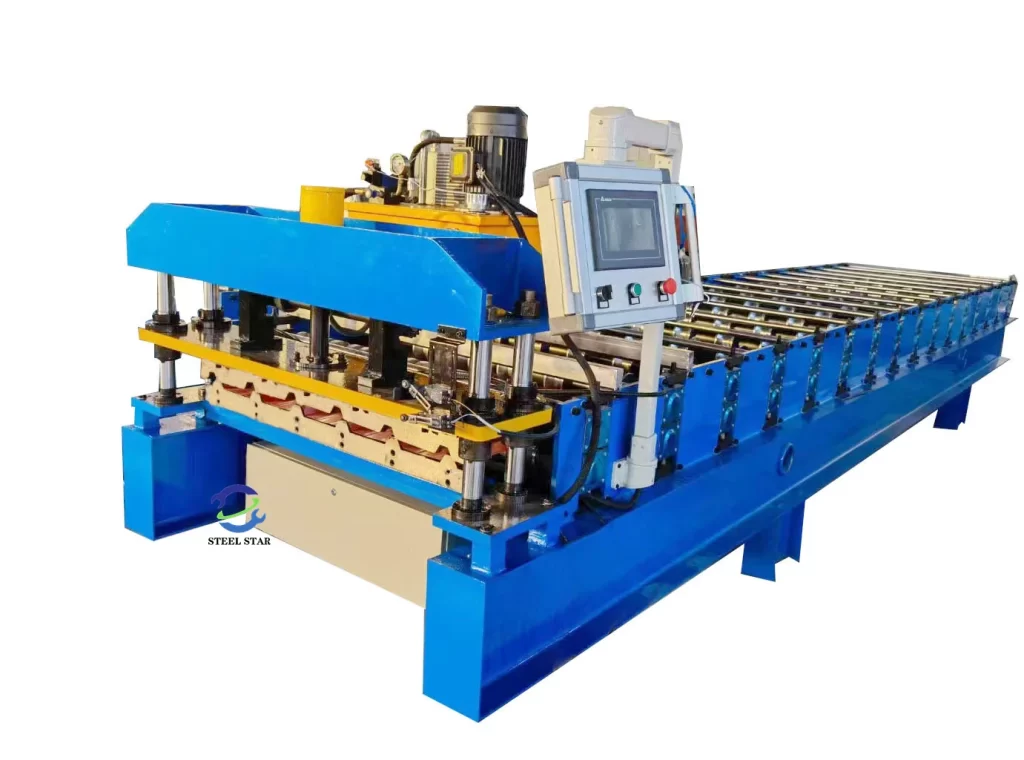
Common Applications
You encounter roll-formed products every day, often without realizing it:
- Construction: Metal roofing and siding panels, purlins, studs, tracks, rain gutters, downspouts.
- Automotive: Door beams, window guides, seat belt anchors, bumper reinforcements.
- HVAC: Ductwork sections, air grilles, frame profiles.
- Storage & Logistics: Pallet rack beams and uprights, shelving supports, drawer slides.
- Solar Energy: Mounting rails and structural supports for photovoltaic panels.
Choosing the Right Machine
When selecting a roll forming machine, consider:
- Material: Type, thickness (gauge), yield strength, and coating (e.g., galvanized, painted, pre-coated).
- Profile Complexity: Number of bends, symmetry, and required tolerances.
- Production Volume: Determines whether a standard, high-speed, or heavy-duty machine is appropriate.
- Line Speed Requirements: Coordinate with downstream processes like punching and cutting.
- Future Flexibility: Do you need an adjustable machine for multiple profiles?
The Future of Roll Forming
Industry 4.0 is transforming roll forming. Modern machines feature:
- Servo-electric drives that reduce energy consumption by up to 60% compared to hydraulic systems.
- Quick-change tooling systems that reduce changeover time from hours to minutes.
- Inline quality monitoring with laser sensors and cameras, providing real-time feedback.
- Integration with MES/ERP for paperless production and predictive maintenance.
As demand for lightweight, high-strength structures grows—especially in electric vehicles and green building—roll forming will continue to evolve, embracing new materials like advanced high-strength steel (AHSS) and aluminum alloys.
The Sheet Metal Roll Forming Machine is a testament to the power of simple, continuous processes. It takes a humble coil of metal and, through a carefully choreographed sequence of rolling stations, creates precision profiles that build our world. While the upfront tooling cost is significant, the unmatched combination of speed, consistency, and material efficiency makes roll forming an indispensable technology for any manufacturer producing long, repetitive metal shapes.
Website:
www.steelstarmachine.com (English)
www.greatforming.com (English)
www.arabicgreatforming.com (عربي)
www.russiangreatforming.com(Русский)
www.spanishgreatforming.com(Español)
www.frenchgreatforming.com(Français)
www.portuguesegreatforming.com(Portuguese)
www.turkishgreatforming.com(Turkish)